Calculation of ATEX connection line parameters - example

Example of calculating the maximum length of the connection line for the PC-28 transducer with the S2Ex-Z barrier
General rules for intrinsically safe cables
- Generally, cables and wires of intrinsically safe circuits should be routed separately from cables and wires of non-intrinsically safe circuits.
- Cables for intrinsically safe circuits should be placed so that they are protected against the risk of mechanical damage. If the cables for intrinsically safe or non-intrinsically safe circuits are armored, metal-sheathed, or shielded, they can run together in both hazardous and non-hazardous areas (e.g., if an intrinsically safe cable is shielded and blue, it can run in a shared cable tray with other non-intrinsically safe cables). Intrinsically safe and non-intrinsically safe circuits should not be run in the same cable.
- The cable shield should be connected to PE grounding on one side only (e.g. only in the safe area) using a wire with a minimum cross-section of 2.5 mm2.
- Maintain a distance of 50mm from the end of the screen braid to the stripped ends of the cable cores in both the hazardous and safe areas.
- Place crimping sleeves on the stripped ends of the cable cores.
- If several intrinsically safe circuits are run in a multi-core intrinsically safe cable, the wires must be type A or B with an insulation test of 500V and the insulation must not be thinner than 0.2mm.
- Cables and wires must be permanently attached and protected against possible mechanical damage.
- It is recommended to use blue cables.
- It is necessary to compare the parameters Uo, Io, Po, Co, Lo, Ui, Ii, Pi, Ci, Li (L, C of the cable and Li, Ci of the device installed in the hazardous area).
Intrinsically safe parameters Uo, Io, Po, Co, Lo, Ui, Ii, Pi, Ci, Li
To correctly select the connecting cable, you must first find the values of the intrinsically safe parameters of the device installed in the zone and the ATEX barrier that will handle the signal from this device.Parameter definitions:
- Uo: The maximum voltage that can ever appear at the output terminals of an intrinsically safe circuit.
- Io: The maximum current that an intrinsically safe output circuit can ever produce.
- Po: The maximum power that can ever output from an intrinsically safe output circuit.
- Co: Maximum capacity of an intrinsically safe circuit.
- Lo: Maximum inductance of an intrinsically safe circuit.
- Ui: The maximum input voltage of an intrinsically safe circuit that can be applied to the terminals without losing the intrinsically safe function.
- Ii: The maximum input current of an intrinsically safe circuit that can flow into the circuit without losing the intrinsically safe function.
- Pi: The maximum input power of an intrinsically safe circuit that the circuit can accept without losing its intrinsically safe function.
- Ci: Maximum internal capacitance of an intrinsically safe circuit.
- Li: Maximum internal inductance of an intrinsically safe circuit.
This information is provided in the catalog cards and/or in the ATEX certificate. These parameters are crucial for ensuring safety in explosion hazard zones.
For example, let's look at a situation where a PC-28/Ex/0...100kPa/PD/G1/2'' pressure sensor for explosion group IIA was used in an explosion hazard zone. This is a two-wire 4...20mA sensor, which, according to the ATEX certificate, has the following intrinsically safe parameters:
- in case of using a power supply with linear characteristics:
Ui=28Vdc, Ii=0,1A, Pi=0,7W, Cin=25nF, Li=0,4mH
- in case of using a power supply with trapezoidal or rectangular characteristics:
Ui=24Vdc, Ii=0,1A, Pi=1,2W, Cin=25nF, Li=0,4mH
When looking for a suitable 4...20mA barrier-power supply, you should pay attention to the characteristics of this circuit, because as you can see above, it must meet other intrinsically safe requirements.
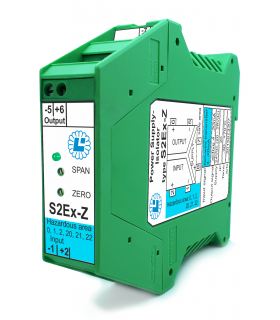
We will consider the use of a power supply-separating barrier type S2Ex-Z. When we open the datasheet we see a table with parameters:

The output circuit of the S2Ex-Z barrier has a trapezoidal characteristic. To meet the requirements for the parameters Ui, Ii, Pi > Uo, Io, Po, we decide on the "-22/92" version. This version, taking into account the explosion group IIA, has the parameters Lo = 26mH, Co = 3.67uF. We do not consider the L / R parameter, because the clustered parameters Li, Ci of the PC-28 transducer are given (this is how they should be treated unless otherwise described).
If the clustered parameters Li, Ci of the device in the hazardous zone are significant in relation to the clustered parameters Lo, Co of the intrinsically safe barrier (understood as Li > 1% Lo and Ci > 1% Co), then (according to norm EN 60079-11:2012) half the Lo and Co values should be taken for calculations of the connecting cable parameters for safety (while this reduced capacitance value Co/2 may not exceed 1uF for groups I, IIA, IIB and III and 0,6uF for IIC). Newer version of the norm EN 60079-11:2025 allows less restrictive reduction factor taken from tables. However, if Li < 1% Lo or Ci < 1% Co, then the Lo, Co values from the table should be taken for calculations.
In this case the Li parameter of the PC-28 transducer exceeds 1% of the Lo value of the S2Ex-Z-22/92 barrier (Li/Lo = 0.4mH/26mH = 1.54%), but not Ci (Ci/Co = 25nF/3.67uF = 0.68%). Therefore, when selecting a cable, the following requirements must be met:
L cable + Li transducer < Lo barrier ; C cable + Ci transducer < Co barrier .
From this you can calculate:
L cable < 26mH - 0,4mH = 25,6mH ; C cable < 3,67uF - 25nF = 3,645uF .
We will assume the cable parameters: L cable =1uH/m, C cable =220pF/m.
We get two conditions for the maximum cable length:
due to L: 25,6mH / 1uH/m = 25600m,
due to C: 3,645uF / 220pF/m = 16568,18m.
A more stringent requirement should be adopted, so for this example the maximum length of the connecting cable can be 16568.18m.